The Art of Proportion: Best Minimalist Watches for Small Wrists (2026 Edition)
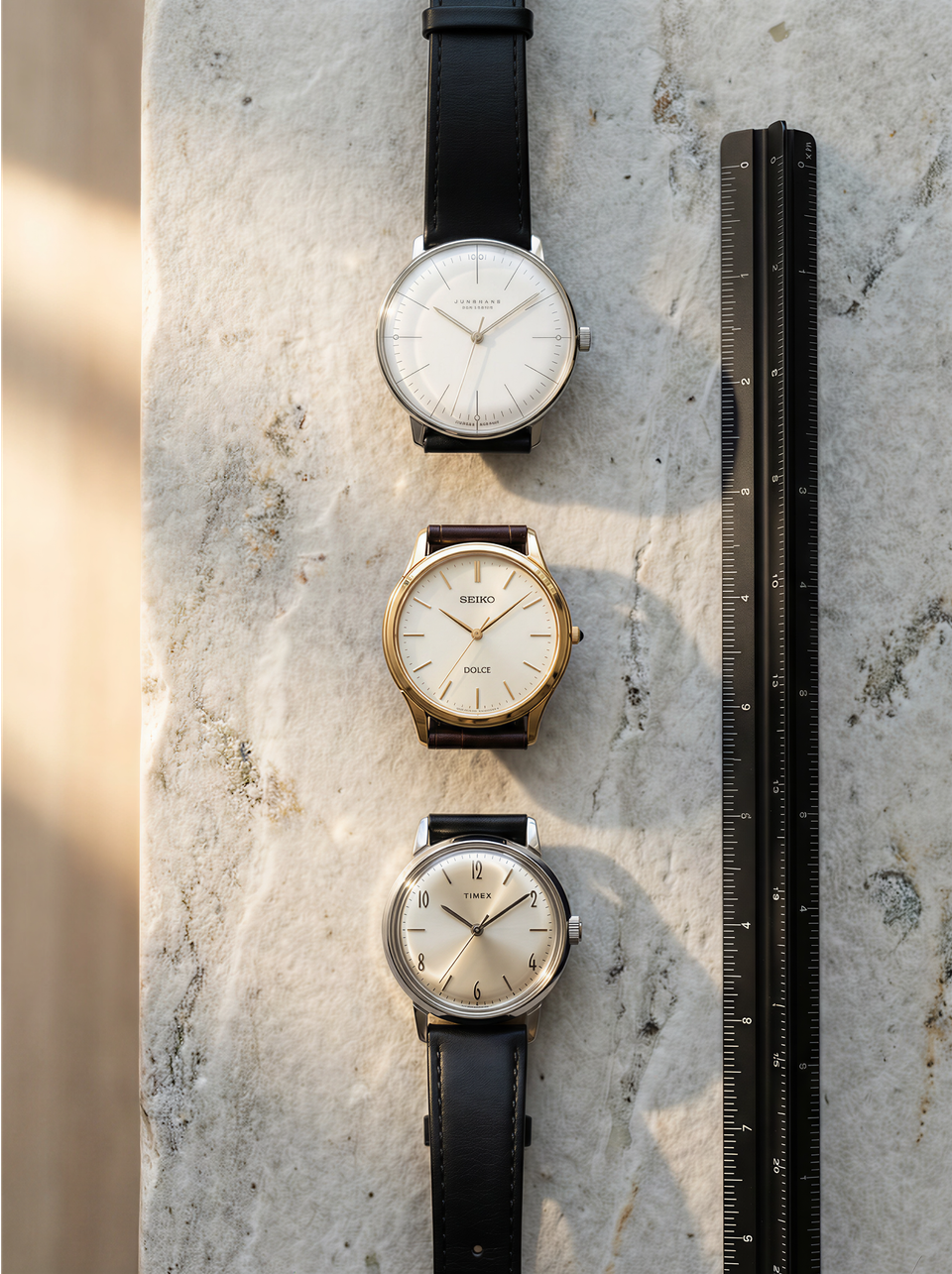
*By Velloris *
There is a quiet deception built into the way watches are sold. Walk into any boutique, browse any retailer, and the number that greets you — 38mm, 40mm, 42mm — is the case diameter: a single measurement taken at the widest point of the dial. It tells you almost nothing about how a watch will actually wear on your wrist. For those of us with smaller wrists, chasing that number alone is how you end up with a perfectly proportioned dial that hangs off both sides of your wrist like a stage overhang.
The metric that actually governs fit is lug-to-lug distance — the measurement from the tip of the upper lugs to the tip of the lower lugs, taken end-to-end across the case. This is the dimension that bridges your wrist, and it is the one most manufacturers prefer to bury in footnotes, if they publish it at all.
This guide exists to correct that. Every recommendation below has been evaluated first on lug-to-lug geometry, then on the design values that define genuine minimalism: restraint, proportion, and the discipline to remove rather than add.
Why Case Diameter Is a Lie (And Lug-to-Lug Is Everything)
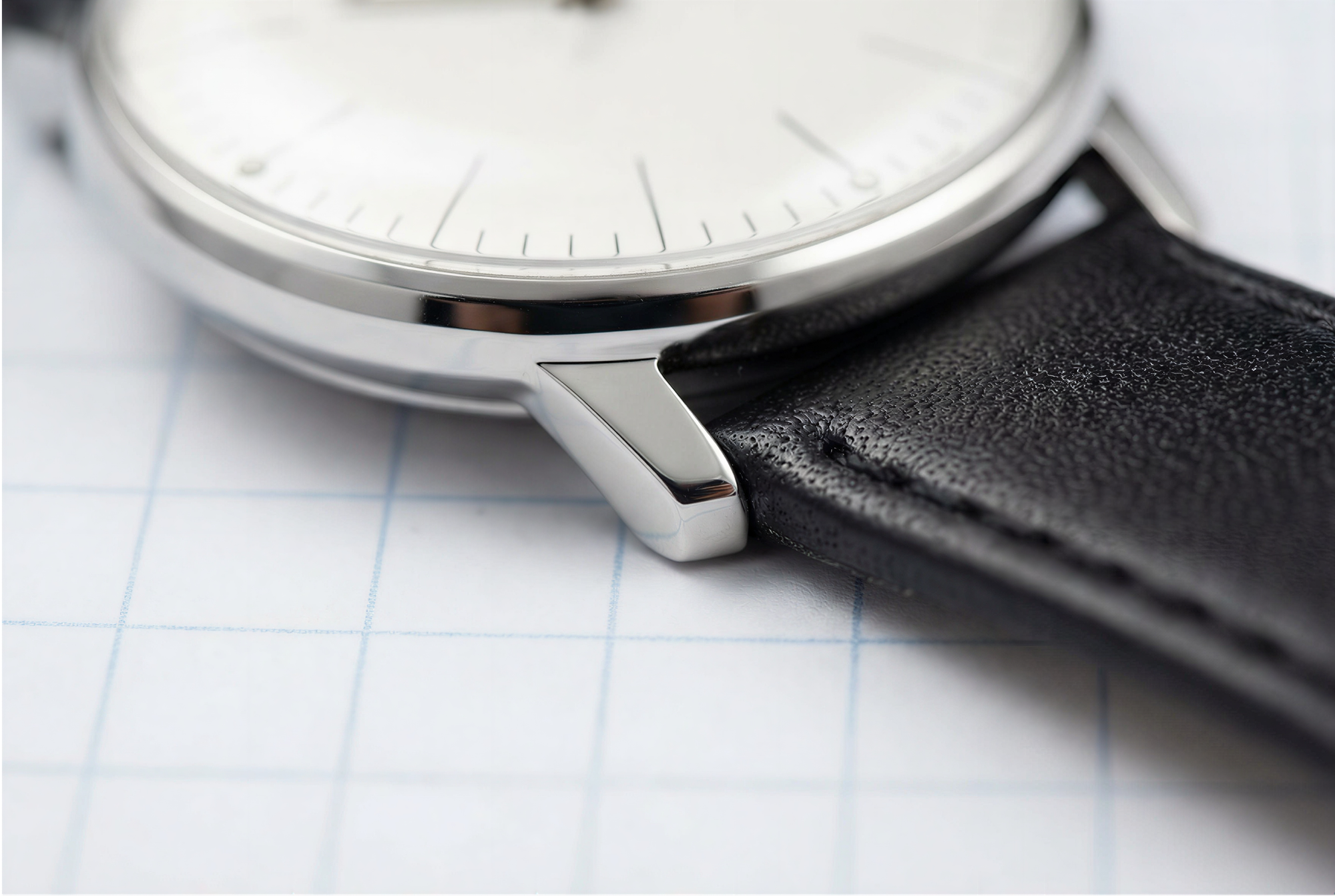
Consider two watches, both 38mm in diameter. The first — the Junghans Max Bill Quartz — has a lug-to-lug of 40mm, owing to its short, closely-set lugs. The second — a generic field watch of the same diameter — might measure 48mm lug-to-lug because of its swept, elongated lugs. On a 6.25-inch wrist, the first watch sits cleanly within the wrist's width. The second overhangs on both sides, creating the visual imbalance that makes a watch look "too big" — not because the dial is too wide, but because the architecture of the case is wrong for the wrist.
For wrists under 6.5 inches, the threshold to understand is this: a lug-to-lug under 42mm will reliably stay within the wrist profile. Under 40mm is the ideal zone. Anything beyond 44mm begins to require conscious justification.
Case thickness matters too, though differently. A watch thicker than 12mm on a fine wrist reads as chunky regardless of diameter. The sweet spot is under 10mm — ideally under 8mm — which allows the case to hug the wrist rather than sit above it.
The best minimalist watches for small wrists, then, are not simply small watches. They are watches with considered lug geometry, restrained case architecture, and dials that understand that a smaller canvas demands even greater design precision.
The 2026 Shortlist: Six Watches That Earn Their Place
The six watches below represent the most compelling choices currently available, drawn from the ateliers of Glashütte, the design studios of Copenhagen, and the precision engineering culture of Tokyo. Each earns its position not merely through specification, but through design integrity.
Comparison Table
| Model | Diameter | Lug-to-Lug | Thickness | Movement | Price (approx.) |
|---|---|---|---|---|---|
| Junghans Max Bill Hand-Winding | 34mm | 37.4mm | 9mm | J805.1 / ETA 2801-2 (Hand-Wind) | ~$1,300 |
| Seiko Dolce SACM171 | 33.5mm | 38.9mm | — | 7771 (High-Accuracy Quartz) | ~$500–$700 |
| Timex Marlin Hand-Wound | 34mm | 41mm | 10mm | Seagull Mechanical (Hand-Wind) | ~$209 |
| Mondaine Evo2 Quartz | 35mm | 41mm | 9mm | Ronda 503/509 (Quartz) | ~$370 |
| Sternglas Naos Quartz | 38mm | 41mm | 8mm | Miyota GR12 (Quartz) | ~$231 |
| Nordgreen Philosopher | 36mm | ~42mm | 7.2mm | Miyota GM12-3H (Quartz) | ~$239 |
Lug-to-lug figures marked with ~ indicate community-verified estimates where manufacturers do not publish official data.
1. Junghans Max Bill Hand-Winding (34mm) — The Gold Standard
Glashütte and the Bauhaus tradition meet in Schramberg, Germany.
The Design Language
Max Bill was not a watchmaker. He was a sculptor, a typographer, a designer of chairs and buildings — and it is precisely that outsider clarity that makes the watch bearing his name so disarmingly resolved. The dial is organized around a single governing principle: every element present is necessary; every element absent was considered and removed. The stick indices are as thin as patience allows. The hands are slender without being fragile. The typography — that understated, custom-drawn sans-serif at 6 o'clock — is a studied act of restraint.
This is a Bauhaus watch for a small wrist in the most literal sense: a product of the conviction that beauty is not ornament, but proportion.
The Fit Factor
At 34mm with a lug-to-lug of just 37.4mm, the Max Bill Hand-Winding is, in engineering terms, ideally sized for wrists between 5.5 and 6.25 inches. The lug-to-lug is the decisive figure here. For a lug-to-lug on a 6-inch wrist, 37.4mm means the case sits entirely within the wrist's width with room to spare — the watch does not bridge the wrist so much as inhabit it. The polished, curved lugs follow the wrist's contour rather than fighting it.
The 9mm case thickness is honest without being heavy. It sits above the wrist rather than into it, but not obtrusively so.
The Velloris Verdict
The Max Bill Hand-Winding is not the watch that asks for your attention — it is the watch that rewards it, and it fits a small wrist better than almost anything made in the last fifty years.
2. Seiko Dolce SACM171 (33.5mm) — The High-Accuracy Legend
From Tokyo's horological tradition: the case that fits by design, not compromise.

The Design Language
Tokyo's contribution to precision watchmaking is often misunderstood in the West as a pursuit of specification rather than aesthetics. The Seiko Dolce SACM171 argues otherwise. It is a dress watch of deliberate quietness — a clean white dial, applied gold-tone indices, and hands that carry just enough warmth to avoid the sterility that afflicts so many minimalist pieces. The dial is uncluttered in a way that feels considered, not empty. There is a civility to it, an awareness of the wrist it will dress.
The Fit Factor
At 33.5mm with a lug-to-lug of 38.9mm, the Dolce SACM171 sets a near-unmatched standard for wearability on fine wrists. The 34mm vs 36mm watch debate is largely academic at this scale — both sizes work for small wrists — but the Dolce's sub-34mm diameter makes it genuinely unobtrusive. Pair that with the compact lug-to-lug, and this is a watch that suits wrists as narrow as 5.5 inches without visual compromise.
Its movement — the 7771 high-accuracy quartz calibre — holds time to within ±10 seconds annually. This is not a watch that performs minimalism. It embodies it, mechanically and aesthetically.
The Velloris Verdict
For those who want the smallest possible footprint and the most accurate possible movement, the Dolce SACM171 is a nearly perfect instrument — and the restraint of its design is Tokyo at its most self-assured.
3. Timex Marlin Hand-Wound (34mm) — The Vintage Icon
American mid-century design, honestly priced, beautifully proportioned.
The Design Language
The Marlin is not trying to be German. It does not invoke Bauhaus principles or cite design manifestos. It simply looks right — the way a well-worn hardback looks right, or a well-made leather satchel. The sunburst dial, the dauphine hands, the Arabic numerals at even hours: these are choices that cohere not through minimalist dogma but through decades of refinement. There is a warmth to the Marlin that cooler, more theoretically rigorous watches sometimes lack. It is minimal in the sense that nothing is excessive, not in the sense that everything has been stripped.
The Fit Factor
The 34mm diameter mirrors the Max Bill's, but the Marlin's 41mm lug-to-lug tells a slightly different story. This is still a well-proportioned watch for watches for thin wrists — 41mm falls comfortably within the acceptable range for wrists down to about 5.75 inches — but it wears with more presence than the Junghans. The case is also thicker at 10mm, which some will appreciate as substance, and others will notice as bulk. The acrylic crystal, prone to minor scratches, acquires a patina that suits the watch's vintage character rather than detracting from it.
The Velloris Verdict
At its price point, the Marlin Hand-Wound offers a level of authenticity — mechanical movement, genuine vintage lineage, correct proportions — that no competitor in this tier can match.
4. Mondaine Evo2 (35mm) — The Swiss Classic
The official clock of Swiss Federal Railways, translated to the wrist.
The Design Language
There is a category of design so embedded in daily life that it becomes invisible — and then, suddenly, seen again, it is startling in its perfection. Hans Hilfiker's Swiss railway clock, designed in 1944, is such a thing. The Mondaine Evo2 carries that design to the wrist with fidelity: the white dial is a study in functional contrast, the black markers are bold enough to read at a glance, and the red lollipop second hand is the single chromatic decision that anchors the whole composition. It is graphic design, not horological ornamentation.
The Fit Factor
At 35mm and 41mm lug-to-lug, the Evo2 occupies the same geometry as the Marlin but wears differently — its bold, high-contrast dial reads as more assertive despite the modest case. For wrists between 5.75 and 6.5 inches, this is a comfortable fit. The 9mm case thickness is a meaningful advantage over the Marlin, keeping the profile lean. The sapphire crystal and Swiss quartz movement justify a higher price than its Scandinavian competitors at this lug-to-lug tier.
The Velloris Verdict
The Evo2 is the rare watch that functions as a genuine design artifact — one with documented cultural heritage — without sacrificing a single degree of wearability.
5. Sternglas Naos Quartz (38mm) — The Modern German Choice
Hamburg's answer to Bauhaus heritage, engineered for the contemporary small wrist.

The Design Language
Sternglas was founded in Hamburg in 2016 with an explicit mandate: to produce Bauhaus-lineage watches at democratic prices. The Naos is the realization of that mandate. Its dial is clean to the point of austerity — a classic railway dial layout, thin applied indices, a discreet date window — and its domed sapphire crystal introduces a touch of vintage-inflected depth that elevates the piece above its specification might suggest. This is a Bauhaus watch for a small wrist in the contemporary idiom: historically literate without being reverential.
The Fit Factor
The Naos's distinction in this comparison is its case architecture. At 38mm diameter — the largest in this shortlist — it should, by the logic of diameter-first thinking, wear too large. It does not. The 41mm lug-to-lug is achieved through short, closely-set lugs, and the 8mm case thickness (the slimmest of the Bauhaus-influenced options here) means the watch sits flush against the wrist rather than hovering above it. For small minimalist watches that want to operate at a 38mm dial, the Naos is the most compelling argument that diameter is, as we've argued, the wrong number to watch.
The Velloris Verdict
The Naos Quartz is the most persuasive case currently available that a 38mm watch can be proportionally correct on a 6-inch wrist — provided someone has paid serious attention to the lugs.
6. Nordgreen Philosopher (36mm) — The Scandi Minimalist
Copenhagen's design culture, expressed at 7.2mm of thickness.
The Design Language
Copenhagen's design philosophy has always distinguished itself from Germany's in one crucial way: where Bauhaus pursued the rational, Scandinavian design pursued the human. The Nordgreen Philosopher, designed with reference to the aesthetic principles of Jakob Wagner, is warm in a way that Bauhaus-derived pieces are not. Its conical dial creates a sense of depth without ornamentation. The asymmetric seconds hand — a detail borrowed from the tradition of Danish industrial design — introduces visual movement that is dynamic without being decorative. Available in a wide range of dial and case colours, it is the most versatile piece on this list.
The Fit Factor
The Philosopher's most significant specification is its 7.2mm case thickness — the slimmest on this list by a meaningful margin. For watches for thin wrists, case thickness is often more perceptible than diameter; a very slim watch disappears under a cuff and sits closer to the skin than a thicker case of identical diameter. The estimated 42mm lug-to-lug sits at the outer edge of the recommended range for wrists under 6.25 inches, but the slim profile compensates, allowing the watch to drape rather than perch. Wrists closer to 6.5 inches will find the fit entirely natural.
The Velloris Verdict
The Philosopher is the watch to reach for when you want Scandinavian warmth over German precision — and its 7.2mm case makes it the most elegant daily wearer on this list for those who dress formally.
How to Choose: A Framework for Small Wrists
The question "what is the best minimalist watch for small wrists?" cannot be answered without first answering a prior question: what is your wrist circumference, and what is the lug-to-lug threshold that keeps a watch within your wrist's width?
As a working framework:
- 5.5 – 6.0 inches (14 – 15.2cm): Target lug-to-lug under 40mm. The Max Bill Hand-Winding and Seiko Dolce are your options at this end.
- 6.0 – 6.25 inches (15.2 – 15.9cm): Lug-to-lug up to 42mm is workable. Every watch on this list is appropriate.
- 6.25 – 6.5 inches (15.9 – 16.5cm): You have flexibility. Lug-to-lug up to 44mm sits cleanly; you may also consider 38–40mm case diameters with conventional lug geometry.
Beyond geometry, minimalism places its own demands on selection. A watch for a small wrist benefits from a thin bezel, which maximizes the dial relative to the case. It benefits from a neutral dial — white, cream, or matte black — that does not compete visually with a face that is already small. And it benefits from a strap that is proportioned to the lug width: an 18mm strap on an 18mm lug, neither pinched nor flared.
Design Lineage: Glashütte, Tokyo, Copenhagen
No conversation about minimalist watchmaking is complete without acknowledging the geography of its origins.
Glashütte, the small Saxon town that rebuilt Germany's watchmaking industry after the war, gave us both the technical tradition and the cultural context for Bauhaus watchmaking. Junghans, though headquartered in Schramberg, draws from this aesthetic lineage directly. The discipline of Glashütte — precision as virtue, ornamentation as weakness — runs through every Max Bill reference.
Tokyo represents a different philosophy: the pursuit of accuracy as its own form of beauty. Seiko's high-accuracy quartz calibres are not marketed as minimalist objects, but they are minimalist in the most rigorous sense — instruments that exist to perform a single function to the highest possible standard, with no element that does not serve that purpose.
Copenhagen has produced, in the last two decades, a wave of watch brands — Nordgreen, Bering, Skagen — that share a common aesthetic DNA: clean lines, connection to natural light, and an instinct for restraint that owes more to furniture design than to horology. The Philosopher is the most intellectually considered of these.
Final Thought
The art of proportion in watchmaking is not the art of making things small. It is the art of making things correct. A 38mm watch with a 41mm lug-to-lug and an 8mm case can be more elegant on a 6-inch wrist than a 34mm watch with ungainly proportions. The numbers that matter are the ones that describe the relationship between the watch and the body it is meant to inhabit.
Every watch on this list understands that relationship. Choose the one whose design language speaks to you — and measure the lug-to-lug before you buy anything.
Velloris.studio covers independent watchmaking, design history, and the intersection of craft and contemporary life. All specifications verified against manufacturer documentation and community-sourced measurements where official data is unavailable.