The Bauhaus Starter Kit: 5 Best Minimalist Watches Under $500 (2026 Edition)
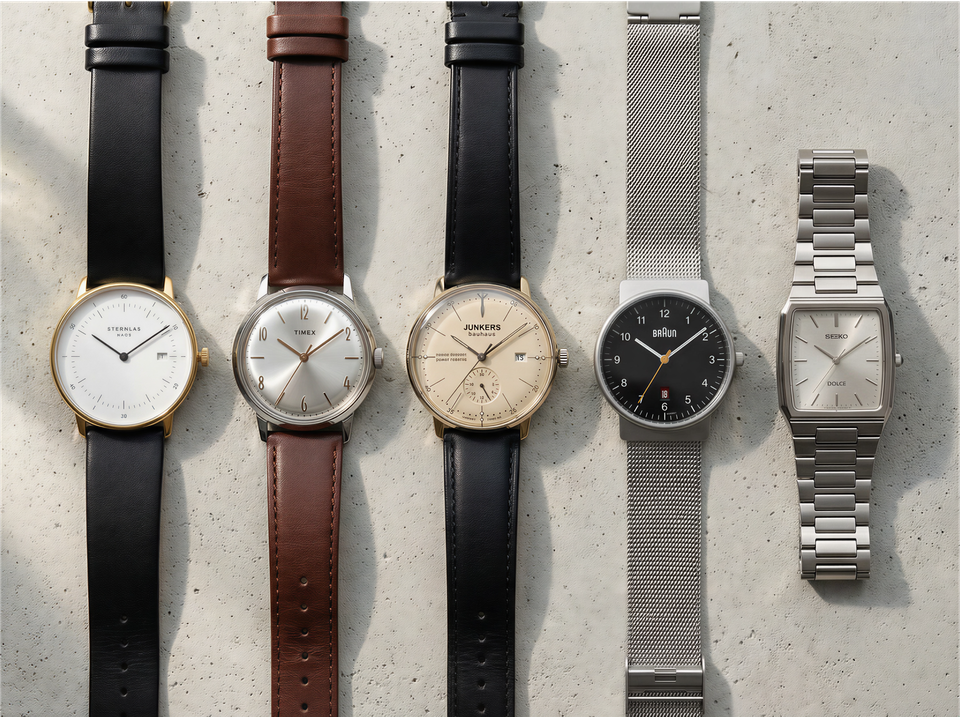
By the Velloris Editorial Team · 2026 Edition
There is a particular kind of fatigue that sets in after years of chasing complications, bezels, and limited releases. Somewhere between the fifth Instagram ad and the third "collab drop," you start to wonder whether a watch is supposed to tell the time or perform anxiety.
Bauhaus design — born in Dessau in 1919 and killed by the Nazis in 1933, yet impossible to extinguish — was always the antidote. Not minimalism for the sake of aesthetic posturing, but minimalism as a moral position: remove what deceives, keep what serves. In 2026, that philosophy has never felt more urgent, or more commercially misunderstood. Most brands slap "Bauhaus-inspired" onto anything with a clean dial. Very few actually understand the lineage.
We do. At Velloris, we've spent months testing, comparing, and wearing the watches in this guide. What follows is not a listicle. It is a considered analysis — drawing on movement calibers, crystal science, design genealogy, and real-world wrist time — of the five best minimalist watches available under $500 right now. Whether you're a collector in London hunting your first serious dress watch, or a design purist in Tokyo who already owns a Grand Seiko and wants something more accessible to rotate in, this guide was written for you.
Let's begin where Bauhaus always begins: with purpose.
Why Bauhaus Watches Matter More in 2026 Than Ever Before
The smartwatch has not killed the mechanical watch. If anything, the relentless notification-driven anxiety of wearable tech has created a genuine counter-movement: people who want a wrist object that does one thing, beautifully, and then stops talking. That's Bauhaus. That's what every watch on this list represents.
But "Bauhaus" is also one of the most abused words in horological marketing. A clean dial does not a Bauhaus watch make. True Bauhaus-lineage design traces back to specific design schools, specific people: Max Bill's work for Junghans in the 1960s, Dieter Rams and Dietrich Lubs' output for Braun through the 1970s and '80s, the Ulm School of Design's rigorous functionalism. The watches in this guide all have a defensible claim to that heritage — some through direct lineage, some through genuine philosophical alignment.
We've organised this as a buyer's dossier, not a review. Price, specs, grey market reality, collector-level pros and cons, and a direct verdict from us. Nothing more.
The Five Watches: In-Depth Analysis
1. Sternglas Naos (Quartz & Automatik) — The German Benchmark
The Sternglas Naos is the watch we recommend most often when someone walks in asking for their first serious minimalist piece. Founded in Hamburg in 2016 — a city with deep roots in precision craftsmanship and Northern European design restraint — Sternglas has built something rare: a brand that earns its awards rather than buying them. The German Design Award is a meaningful credential here, not marketing wallpaper.
The Naos exists in two variants, and the choice between them is a real one.
Technical Specifications
| Specification | Naos Quartz | Naos Automatik |
|---|---|---|
| Case Diameter | 38 mm | 38 mm |
| Thickness | 8 mm (6mm case) | 12 mm |
| Lug-to-Lug | 41 mm | 43 mm |
| Movement | Miyota GR12 Quartz | Miyota 8215 Automatic |
| Crystal | Domed Sapphire, Double AR-Coated | Domed Sapphire, Double AR-Coated |
| Water Resistance | 5 ATM (50 metres) | 5 ATM (50 metres) |
Design Heritage
The Naos is a direct descendant — philosophically, not literally — of the Max Bill design language developed for Junghans in the 1960s. The clean, expansive dial. The considered placement of the date at 6 o'clock, which preserves the bilateral symmetry that strict Bauhaus composition demands. The absence of unnecessary text on the dial. These are not coincidental choices.
What separates the Naos from a dozen impostors at similar price points is the domed sapphire crystal with double anti-reflective coating on both sides. At this price tier, most competitors use flat mineral glass or, at best, uncoated sapphire. The dome adds a subtle vintage convexity that photographs beautifully and reads as intentional. It is.
The Miyota 8215 in the Automatik is a widely-used movement — you'll find it in a great many watches at this price. It's reliable, it's proven, and it keeps accurate time. The honest critique: older versions lack a hacking mechanism (stopping the seconds hand when you pull the crown to set time), and the rotor can audible when you move your wrist sharply. Neither is a dealbreaker, but both are worth knowing.
The Quartz version, running the Miyota GR12, collapses the case to just 8mm total thickness. On a 6.5-inch wrist, it essentially disappears under a shirt cuff — which is precisely the point.
2026 Pricing
- Retail (Sternglas Official): Naos Quartz ~€215 (~$235 USD) · Naos Automatik ~€395 (~$430 USD)
- Grey Market (e.g., Fargo Time): Naos Automatik ~$310–$350 USD, often bundled with extra straps
Velloris Verdict
The Naos Quartz is, by some margin, the best minimalist watch available under $250. The Automatik requires a slightly harder justification given its thicker profile, but for those who want a self-winding movement with genuine Bauhaus DNA and a sapphire crystal, there is nothing else at this price that competes. Start here.
2. Junkers Bauhaus 6060-5 — The Complication You Didn't Know You Needed
The connection between Hugo Junkers and the Bauhaus movement is genuine history, not marketing mythology. Junkers' aircraft factories in Dessau were a literal neighbour to the Bauhaus school — the same city, the same decade, the same ethos of radical functional design applied to industrial objects. The Junkers watch brand draws on that lineage, and the 6060-5 is the most interesting expression of it at an accessible price.
What makes the 6060-5 unusual: it has a power reserve indicator. At this price point, that is essentially unheard of.
Technical Specifications
| Specification | Junkers Bauhaus 6060-5 |
|---|---|
| Case Diameter | 40 mm |
| Thickness | 12 mm |
| Lug-to-Lug | 43.4 mm |
| Movement | Miyota 9132 Automatic |
| Crystal | Hesalite (Acrylic) |
| Water Resistance | 3 ATM (30 metres) |
Design Heritage
The 6060-5's dial is a study in what we'd call instrument minimalism — a distinctly German sub-genre that treats the watch face as a precision readout rather than an aesthetic canvas. The beige dial, slim applied hands, and the crisp typography of the hour markers evoke a vintage altimeter more than a dress watch. The power reserve sub-dial and 24-hour indicator are integrated with enough compositional intelligence that they add visual interest without creating clutter. It's a difficult balance, and the 6060-5 achieves it.
The Miyota 9132 is a step up from the 8215 series — a more sophisticated calibre with the power reserve complication built in. The trade-off is acoustic: the rotor on 9-series Miyota movements is notoriously noisy. Some collectors find this charming. Others find it intolerable in a quiet room. We'd put ourselves in the former camp, but it's a known characteristic worth flagging.
The Hesalite crystal is the 6060-5's most significant material weakness. Acrylic scratches. It polishes back out easily with a cloth and some Polywatch, but if you wear your watches hard, the 5060-5 will show it. On the other hand, acrylic doesn't shatter — and there's an argument that on a vintage-inspired piece like this, a few hairline scratches are part of the patina.
2026 Pricing
- Retail (Original): ~$499 USD
- Grey Market (Chrono24, eBay): $450–$550 USD depending on condition and seller
Velloris Verdict
The most characterful watch on this list. If you're drawn to the idea of a Bauhaus design with genuine horological complexity — a complication that means something rather than just looking interesting — the 6060-5 is your watch. Just factor in the crystal and the limited water resistance. This is a desk-to-dinner watch, not a travel companion.
3. Timex Marlin Hand-Wound 34mm — The Honest Vintage
There is a version of this guide that dismisses the Timex Marlin as too entry-level, too mainstream, too American for a conversation rooted in Bauhaus and German-Japanese design heritage. That version of this guide would be wrong.
The Marlin at 34mm with a hand-wound movement is something genuinely rare in 2026: an honest watch. It doesn't pretend to be something it isn't. It is a faithful reissue of a 1960s Timex model — specifically descended from the 1969 Timex Viscount — at a price that makes it accessible to almost anyone. For that, it deserves serious respect.
Technical Specifications
| Specification | Timex Marlin Hand-Wound 34mm |
|---|---|
| Case Diameter | 34 mm |
| Thickness | 10 mm |
| Lug-to-Lug | 41 mm |
| Movement | Chinese Mechanical Hand-Wound |
| Crystal | Acrylic |
| Water Resistance | 3 ATM (30 metres) |
Design Heritage
The Marlin reissue is historically scrupulous in a way that warms our hearts. Timex has retained the boxed cardinal hour markers, the applied indices with their black and gold borders, the mid-century typeface. Even the sunburst dial — a detail that could easily have been value-engineered out — is present. Hodinkee praised the Marlin for its lack of fauxtina, that manufactured artificial aging that plagues so many vintage-inspired watches. This watch doesn't pretend to be old. It simply is what it always was.
The hand-wound movement requires a daily ritual: each morning, you wind it. Twelve to fifteen half-turns of the crown. This is not an inconvenience. It's an act of attention — a moment of physical connection with an object that asks something of you in return for telling you the time. In a world of perpetual motion sensors and haptic alerts, we find this quietly radical.
The Chinese-made movement is not a precision calibre. It keeps adequate time and it is serviceable. At $199 retail, you are not paying for movement technology. You are paying for design integrity and the pleasure of a hand-wound experience.
2026 Pricing
- Retail (Timex Official): $199 USD
- Grey Market (Jomashop, eBay): $150–$210 USD
Velloris Verdict
The gateway watch. If someone tells us they're "watch-curious" but intimidated by the hobby, we hand them a Marlin. Under $200, hand-wound, historically accurate, beautifully proportioned for smaller wrists. The acrylic crystal is this watch's only meaningful limitation — treat it carefully or budget $15 for a Polywatch polishing kit.
4. Braun Classic BN0021 — The Design School Relic
We are required, at this point, to say something that sounds like hyperbole but is simply factual: the Braun BN0021 is one of the most historically significant objects you can wear on your wrist for under $200. This is not a watch that was inspired by industrial design history. It is industrial design history, brought forward in time.
Dieter Rams. Dietrich Lubs. Braun. The Ulm School of Design. These are not names you drop for credibility at dinner parties. They are the actual source code of modern minimalism — from Muji to Apple's early years, from Helvetica's ubiquity to the architecture of Zaha Hadid's early projects. The BN0021 is a direct continuation of the AW 10 watch designed in 1989. Every design decision is defensible. Every detail that remains has survived a rigorous audit of necessity.
Technical Specifications
| Specification | Braun Classic BN0021 |
|---|---|
| Case Diameter | 38 mm |
| Thickness | 8.5 mm |
| Lug-to-Lug | ~44 mm (estimated) |
| Movement | Japanese Quartz |
| Crystal | Mineral Glass |
| Water Resistance | 5 ATM (50 metres) |
Design Heritage
The yellow seconds hand. This is the detail we return to every time. Borrowed directly from Braun's 1960s alarm clock designs — where a vivid seconds indicator served a functional purpose in a domestic setting — it reappears here as the sole concession to colour on an otherwise monochromatic dial. It is not decoration. It is precedent, maintained with discipline across decades.
The "less but better" philosophy Rams articulated — weniger, aber besser — is present in every millimetre of this watch. The stick hands are perfectly legible. The dial typography is neutral to the point of invisibility. The case proportions are neither fashionably large nor precious. It simply works.
Collector consensus on the BN0021 has settled into a useful phrase: "great design, mediocre watch." We think this is fair. The mineral glass crystal is adequate but not exceptional. The basic Japanese quartz movement is reliable but brings no horological distinction. The leather strap benefits from an immediate aftermarket upgrade. You are not buying horological substance. You are buying 35 years of design philosophy distilled into 38mm of case metal.
2026 Pricing
- Retail (Braun Official): $160 USD
- Grey Market (Amazon): $130–$160 USD
Velloris Verdict
Essential. Even if you never wear it daily, own one. The BN0021 is the reference point against which other minimalist watches should be measured — not because it's technically superior, but because it is ideologically pure. For collectors based in design-forward cities like London, Berlin, or Zürich where the Dieter Rams legacy is actively taught and debated, this watch carries a particular resonance. Upgrade the strap immediately.
5. Seiko Dolce SACM171 — Tokyo's Quiet Masterpiece
Everything about the Seiko Dolce SACM171 resists easy categorisation. It is not a Bauhaus watch in the German sense — it emerges from a completely different design tradition, rooted in the precision-craft culture of Tokyo and the exacting standards that Seiko applied to its high-end JDM (Japanese Domestic Market) collections through the 1980s. Yet it belongs on this list because it represents minimalism executed with technical mastery at a price that would be frankly impossible from a Swiss manufacturer.
This is a connoisseur's pick. It will not be for everyone. Those who recognise what they're looking at will not be able to look away.
Technical Specifications
| Specification | Seiko Dolce SACM171 |
|---|---|
| Case Diameter | 33.5 mm |
| Thickness | 5.3 mm |
| Lug-to-Lug | 38.9 mm |
| Movement | Seiko 8J41 High-Accuracy Quartz |
| Crystal | Sapphire, AR-Coated |
| Water Resistance | 3 ATM (30 metres) |
Design Heritage
The Dolce line was introduced in the 1980s as a prestige quartz collection running parallel to the Grand Seiko range — which is to say, it was designed for people who understood that quartz could be an expression of the highest watchmaking ambition rather than a compromise. The SACM171 inherits that legacy directly.
The textured dial is the first thing you notice: it carries the same visual depth as Grand Seiko's famous Snowflake dial, achieving light-diffusion effects through surface treatment rather than colour. The dauphine hands are polished with the kind of precision — sharp ridgelines, mirror facets — that Swiss brands charge four times the price to deliver. And the 5.3mm case thickness is extraordinary. Slipping the SACM171 under a dress shirt cuff is a near-frictionless experience.
Then there is the movement. The Seiko 8J41 High-Accuracy Quartz is accurate to ±10 seconds per year. Not per month. Per year. This surpasses the performance of most luxury Swiss quartz calibres and makes a compelling argument that "quartz" need not be a pejorative. This is the movement equivalent of a track athlete who never makes the news because they just quietly run faster than anyone else, every time.
The SACM171 is a JDM model, which means it is not sold through standard retail channels outside Japan. This makes it a grey-market purchase for most buyers — which comes with the usual caveats around warranty and provenance, but also represents a genuine value opportunity.
2026 Pricing
- Retail (Japan): ¥66,550 JPY (~$440 USD)
- Grey Market (Chrono24, Sakura Watches): $350–$450 USD
Velloris Verdict
The most technically accomplished watch on this list. If you appreciate precision as a form of beauty — if the idea of ±10 seconds per year from a 5.3mm case genuinely excites you — the SACM171 will reward you in ways you'll discover slowly, over months of wearing it. The 33.5mm case is small by contemporary standards. Wear it, and you'll understand why smaller watches have always been the correct choice for a dress watch.
Full Comparison Table
| Feature | Sternglas Naos (Q/A) | Junkers 6060-5 | Timex Marlin 34mm | Braun BN0021 | Seiko Dolce SACM171 |
|---|---|---|---|---|---|
| Diameter | 38 mm | 40 mm | 34 mm | 38 mm | 33.5 mm |
| Thickness | 8 / 12 mm | 12 mm | 10 mm | 8.5 mm | 5.3 mm |
| Lug-to-Lug | 41 / 43 mm | 43.4 mm | 41 mm | ~44 mm | 38.9 mm |
| Movement Type | Quartz / Auto | Automatic | Hand-Wound | Quartz | HAQ (High-Accuracy Quartz) |
| Crystal | Sapphire | Hesalite | Acrylic | Mineral | Sapphire |
| Water Resistance | 5 ATM | 3 ATM | 3 ATM | 5 ATM | 3 ATM |
| Retail Price | $235 / $430 | ~$499 | $199 | $160 | ~$440 |
| Grey Market | $215 / $310–$350 | $450–$550 | $150–$210 | $130–$160 | $350–$450 |
How to Choose: A Velloris Decision Framework
Before we close, a few honest filters.
If you want the most watch for your money, in terms of materials and all-around specification, the Sternglas Naos Quartz is almost inarguably the correct answer below $250.
If mechanical movement is non-negotiable and you want something with genuine design complexity, the Junkers 6060-5 earns its price. Accept the crystal's limitations.
If you're new to watches and want a piece that will age gracefully with you while costing under $200, buy the Timex Marlin. Wind it every morning. Let it teach you something.
If you care about design lineage more than horological specification — if you want to wear a piece of the Ulm School on your wrist — the Braun BN0021 is irreplaceable. Swap the strap.
If you are a precision obsessive who appreciates Japanese craft culture, understands why a 5.3mm case is an engineering achievement, and doesn't mind navigating grey market purchasing to access a JDM model, the Seiko Dolce SACM171 is the most genuinely exceptional watch on this list. The collectors who know, know.
A Final Word on Bauhaus and Buying Well
The best minimalist watches don't announce themselves. They don't need to. They tell the time with clarity, they sit on the wrist without demanding attention, and they reward the wearer with the quiet satisfaction of owning something that was designed with integrity rather than assembled with ambition.
From the design studios of Hamburg to the precision workshops of Tokyo, from the Dessau legacy of Walter Gropius to the Braun archives in Kronberg — the Bauhaus tradition is global now, and it belongs to anyone who chooses to engage with it seriously.
These five watches are five entry points. Each one is defensible. None of them will embarrass you in front of someone who knows.
That's the Velloris standard. Start well, buy once, wear always.
Enjoyed this guide? Explore the full Velloris Journal for more considered horological writing, independent brand profiles, and technical deep-dives into the watches worth understanding.
Disclosure: Some links in this post are affiliate links. Velloris earns a small commission if you purchase via these links, at no additional cost to you. We only recommend watches we have genuinely tested and stand behind.