The Architect's Wrist: A Deep Dive into the Junghans Max Bill Automatic
By Velloris | Minimalist Watch Reviews
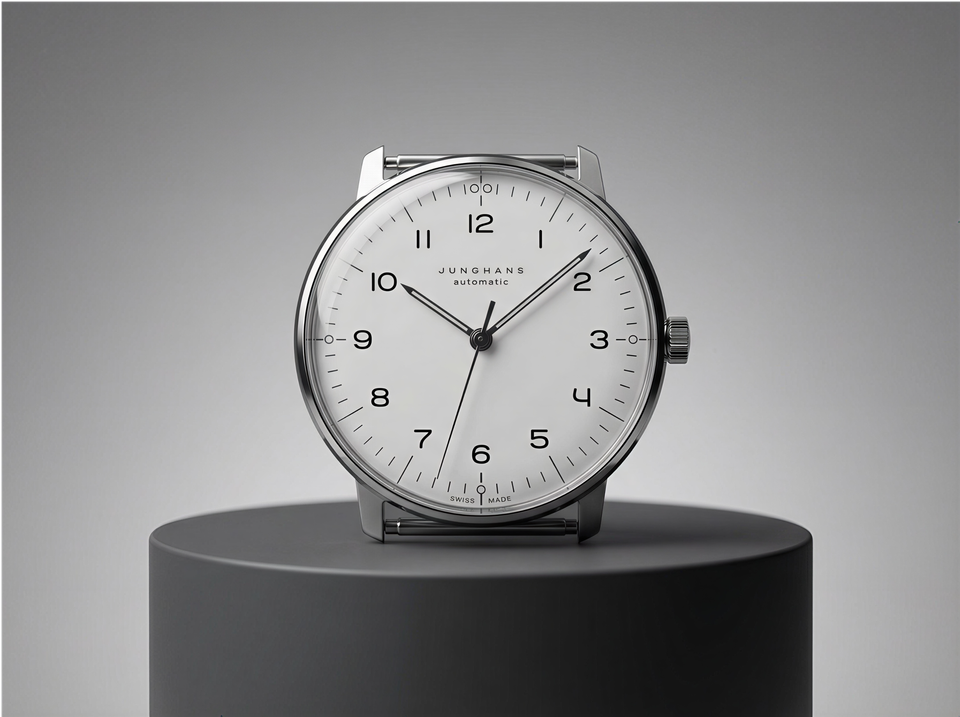
There are watches that try to be minimal. Then there is the Junghans Max Bill Automatic — a watch that is minimal, because it couldn't have been otherwise. It did not arrive through the language of marketing or trend-chasing. It arrived through the logic of a Bauhaus-trained artist who believed that beauty and function were not a trade-off, but a covenant.
This is not merely a minimalist automatic. It is one of the most intellectually coherent objects in watchmaking.
Technical Specifications
| Feature | Specification |
|---|---|
| Reference | 027/3500.04 |
| Case Diameter | 38.0 mm |
| Case Thickness | 10.0 mm |
| Movement | J800.1 (ETA 2824-2 base) |
| Crystal | Domed Hesalite with SICRALAN coating |
| Water Resistance | 30 Meters (3 BAR) |
| Lug-to-Lug | ~39.7–40 mm |
| Lug Width | 18 mm |
| Weight (on leather) | ~60 grams |
| Power Reserve | 38 hours |
| Strap | Calf leather or Milanese bracelet |
The Bauhaus Connection: From Kitchen Clock to Wrist
To understand the Max Bill watch, you have to go back not to a watchmaker's bench, but to a Bauhaus classroom in Dessau, 1927. That is where a young Max Bill — silversmith's apprentice turned design student — absorbed the teachings of Wassily Kandinsky, Paul Klee, and Oskar Schlemmer. What he took from those rooms was not a style. It was a method: the idea that the form of any object should arise directly and honestly from its purpose.
Bill went on to found the Ulm School of Design in Germany, becoming one of the most rigorous proponents of what he called die gute Form — "the good form." His philosophy was rooted in Concrete Art: geometric abstraction, precise proportions, and the complete rejection of ornament as decoration for its own sake.
The first major object to carry this philosophy into the domestic sphere was the 1956 Küchenuhr — the kitchen clock Junghans commissioned from Bill. That iconic reverse-teardrop form, now a permanent resident of New York's Museum of Modern Art, demonstrated something quietly radical: that a kitchen timer could be genuinely beautiful if its form followed its function with complete discipline.
By 1961, Junghans invited Bill to translate that same logic onto the wrist. The result was a watch so resolved, so internally consistent, that its fundamental geometry has remained essentially unchanged for over sixty years. The first models were 33mm — white dials, three stick hands, no numerals, no date window. Pure function. Pure Bauhaus.
The 38mm automatic you are considering today is a direct descendant of that original act of restraint.
The Design Hook: Why This Watch Earns a Second Look
The No-Bezel Illusion
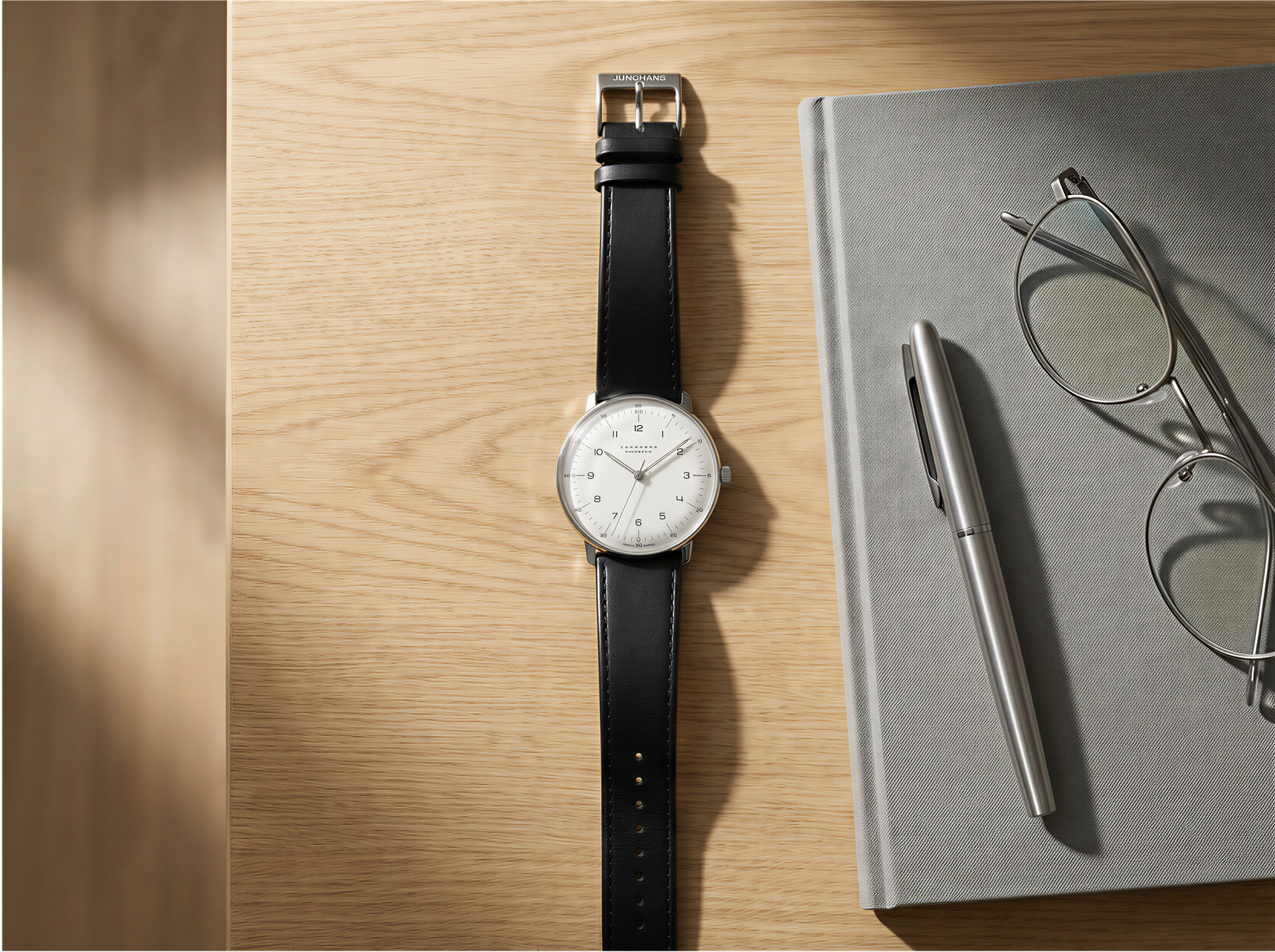
The single most disorienting thing about the Max Bill Automatic, for someone encountering it for the first time, is that it wears substantially larger than its 38mm case size suggests. This is not an accident of proportion — it is the direct consequence of a design decision made in the 1960s and faithfully maintained since.
There is, functionally speaking, no bezel. The dial extends nearly to the edge of the case, the crystal dome curves dramatically outward toward the periphery, and the hands themselves follow the curvature of the dial — a detail so precise it becomes almost uncanny under strong light. The effect is of a dial that has escaped its case, spreading across the wrist with an authority that watches twice its price fail to project.
For a 6.5-inch wrist, the short lug-to-lug distance of roughly 39.7–40mm means the watch sits flat and flush, without the lugs overhanging. It wears big because it is all dial, but it fits because it is architecturally compact.
The Hooked '4': A Signature in Typeface
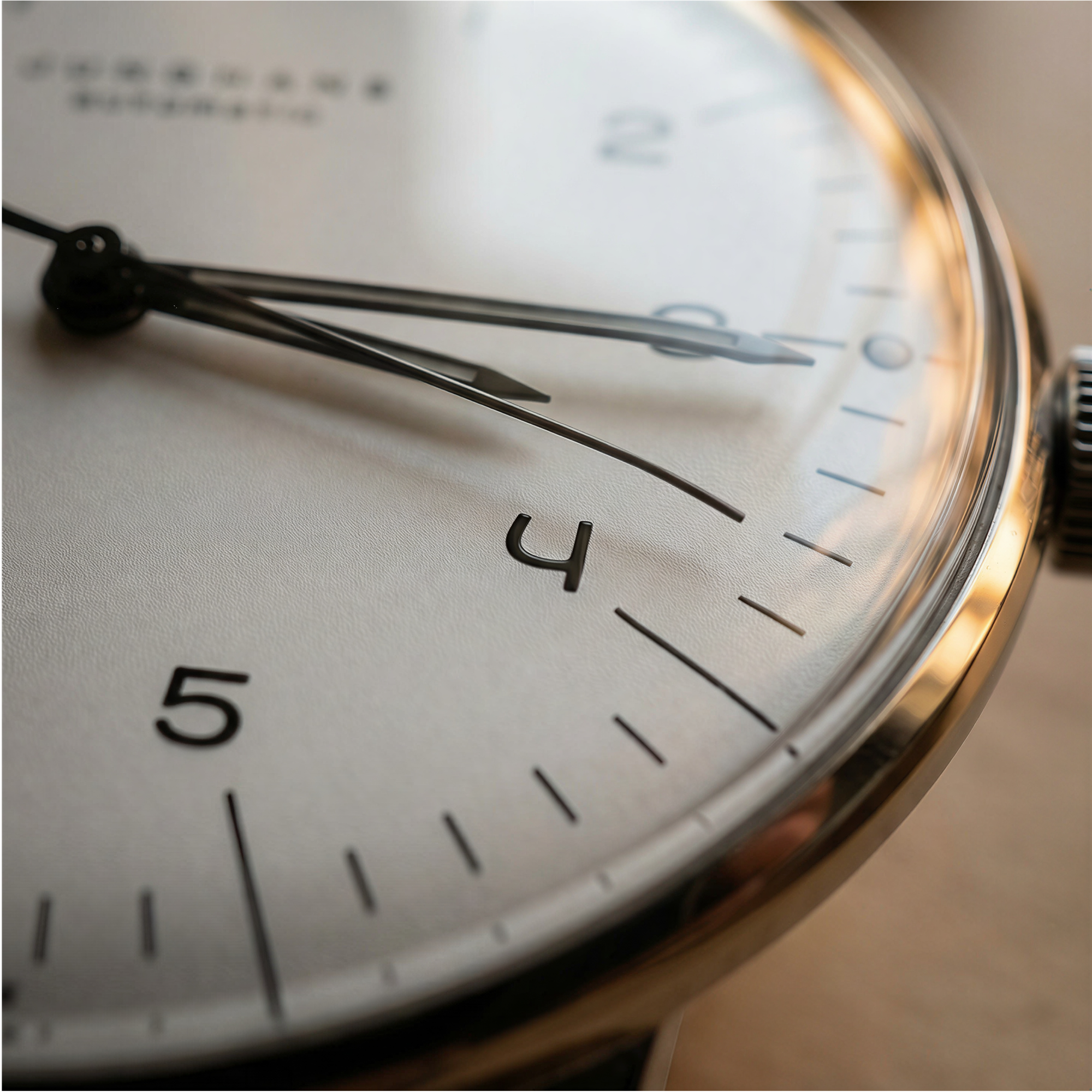
On the numerical dial variant, Max Bill designed every character himself. The numerals are rounded, unembellished, and almost warmly human — a counterpoint to the cool geometry of the case. But among them, the '4' is singular.
Rather than the closed, angular form found on virtually every other watch typeface, Bill's '4' features an open, hooked top. It is immediately recognisable once you know to look for it, and once seen, it becomes the lens through which the entire dial is understood differently. This is not decoration. It is the typographic equivalent of a signature — proof that a human mind, not a committee, made this watch.
Bill designed this typeface originally for the 1956 Exacta kitchen clock. That it migrated to the wristwatch intact is a reminder that for him, design was not a series of individual decisions but a coherent visual language.
The hooked '4' is, in short, the most quietly subversive detail on any Bauhaus watch available today.
Hesalite vs. Sapphire: The Case for Warmth
The Ref. 027/3500.04 uses a domed Hesalite (plexiglass) crystal with a SICRALAN hard coating — and this choice is worth defending, because Junghans has moved newer references toward sapphire, and the community is divided.
The Hesalite crystal does something sapphire struggles to replicate: it bends. Its dome is more pronounced, deeper, and more consistent with the original design intent. Under soft light — candlelight, morning sun, the glow of a reading lamp — it produces a warmth and depth that sapphire's cold clarity cannot match. The hands and dial seem to float within it, at a slight remove from the world.
The sapphire versions, by many community accounts, have a flatter, slightly "off" dome shape that disrupts the visual coherence of the design. The domed crystal is not merely a feature. It is the design.
The SICRALAN coating makes the Hesalite harder than standard acrylic, though it will accumulate light scratches over years of wear, and standard polishing compounds like Polywatch are less effective on it than on uncoated acrylic. For some, this is a fatal flaw. For others, it is simply the patina of a watch that has been lived with — a quality that sapphire, to its credit and its limitation, will never develop.
Styling: The Watch That Gets Out of the Way
The Max Bill's supreme virtue as a wardrobe piece is its complete neutrality. It does not insist on itself.
On a white Oxford shirt under a navy suit, the cream or white dial reads as understated confidence — the horological equivalent of a well-chosen pen. Paired with a leather strap, it is at home in boardrooms, seminar halls, and long-haul departure lounges. Dressed down with a fine merino roll-neck or raw denim, it shifts register entirely without effort. The watch does not change; the context does.
It is, in the best Bauhaus sense, a tool that transcends its category.
How It Compares: Context for Discerning Collectors
For readers navigating the minimalist watch landscape, a few brief coordinates:
The Baltic MR01 occupies a different register — French vintage aesthetics, a cushion case with genuine retro warmth, and a more overtly nostalgic personality. Where the Max Bill draws on German industrial design philosophy, the Baltic draws on Parisian café culture. Both are excellent; they are not interchangeable.
The anOrdain Model 1 is an exercise in artisanal rarity — Scottish enamel dials fired by hand, each one unique, each one irreproducible. It is the watch as craft object rather than design object. Its emotional pull is completely different from the Max Bill's intellectual rigour, and its price reflects its handmade nature.
The Max Bill exists in its own lane: a Bauhaus watch grounded in design history, produced with Swiss movement reliability, and priced accessibly relative to its cultural weight.
FAQ
Is the plexiglass crystal scratch-prone?
Yes, with nuance. The SICRALAN coating makes this Hesalite harder than standard acrylic, so it resists casual scratches better than an uncoated crystal. Over several years of regular wear, however, fine surface scratches will accumulate — particularly if the watch encounters keys, belt buckles, or rough surfaces. Standard polishing compounds are less effective on SICRALAN than on plain acrylic. If you want a watch to remain pristine with zero maintenance, the sapphire models are more appropriate. If you can accept a crystal that develops character over time — and appreciate the design advantages it brings — the Hesalite is the more authentic choice.
Does it fit a 6.5-inch wrist?
Comfortably. The short lug-to-lug distance of approximately 39.7–40mm is specifically suited to smaller and mid-range wrists, with the lugs sitting flush rather than overhanging. Community consensus on Watchuseek consistently rates the 38mm as the better fit for wrists in the 6–6.75-inch range. Bear in mind that the all-dial design makes it wear larger than 38mm — closer to the visual presence of a 40mm — so those accustomed to larger watches will find it registers on the wrist without difficulty.
Final Verdict
Buy it if...
- You are drawn to the intellectual heritage of the Bauhaus and want a watch that carries that lineage honestly rather than decoratively.
- You value proportion and design restraint over complication or luxury signalling.
- You wear a 6–7-inch wrist and want a minimalist automatic that wears fluidly across formal and casual contexts.
- You prefer the warmth and depth of a domed Hesalite crystal and accept its long-term patina as part of the object's life.
- You want a meaningful entry into the upper tier of design-led watches without the sharp end of Swiss luxury pricing.
Skip it if...
- A scratch-prone crystal is a dealbreaker and you refuse a service or crystal-swap down the line.
- You need water resistance beyond splashes — the 30m rating is for incidental moisture only.
- Movement provenance matters to you and you require genuine in-house manufacture.
- You prefer a watch with immediate visual presence: the Max Bill's beauty is patient and rewards attention rather than announcing itself.
The Junghans Max Bill Automatic is not a perfect watch. No watch is. But it may be the most honest watch at its price point — honest about what it is, where it came from, and what it is trying to do. In an industry saturated with retrograde pastiche and luxury theatre, that honesty is, quietly and without ceremony, rather extraordinary.
Velloris is an independent publication. All opinions are our own.