What Size Watch Is Right for Your Wrist?
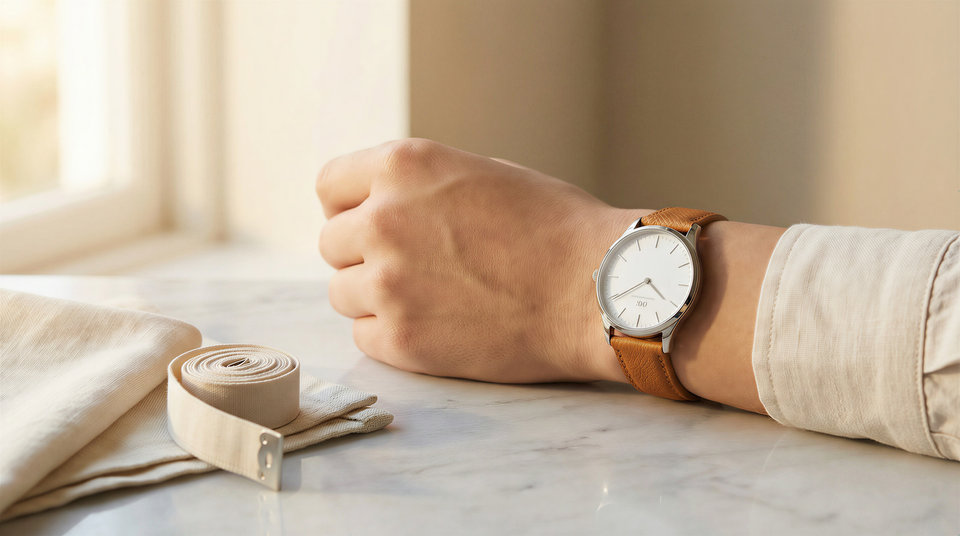
The complete guide to minimalist watch sizing, fit, and the golden rules that make all the difference.
There is a quiet revolution happening on the wrist. After two decades of watches that announced themselves before you even entered the room — thick-cased, broad-shouldered dive watches stacked high above the cuff — the pendulum has swung back. The 2026 watch world is rediscovering something the best dressers always knew: that restraint is the most powerful statement of all.
But choosing a minimalist watch is not simply a matter of reaching for something "not too big." It requires understanding a few precise, interconnected rules — and one counterintuitive truth. A slender, open-dialled minimalist watch can wear larger on the wrist than a chunky diver with the same case diameter. Understanding why is the foundation of getting your next timepiece exactly right.
The Outline at a Glance
- The Wrist-to-Case Ratio: Your Starting Point
- The 60–75% Rule Explained
- Why Minimalist Watches Wear Larger Than Dive Watches
- Lug-to-Lug: The Measurement That Actually Matters
- Case Thickness and the Minimalist Profile
- 2026 Trend: The 36–38mm Sweet Spot
- How to Measure Your Wrist (Step-by-Step)
- The Three Fit Mistakes That Ruin a Minimalist Silhouette
1. The Wrist-to-Case Ratio: Your Starting Point
Every conversation about watch sizing begins here. The case diameter — measured side to side, typically excluding the crown — is the number printed on every specification sheet and discussed in every review. But it is only the beginning.
As a baseline, use this table to identify the right case diameter for your wrist circumference:
| Wrist Size Category | Wrist Circumference (Inches) | Wrist Circumference (cm) | Recommended Case Diameter |
|---|---|---|---|
| Extra Small | Under 6.0" | Under 15.2 cm | 34mm or under |
| Small | 6.0" – 6.5" | 15.2 cm – 16.5 cm | 34–36mm |
| Medium (Average) | 6.5" – 7.0" | 16.5 cm – 17.8 cm | 36–38mm |
| Large | 7.0" – 7.5" | 17.8 cm – 19.0 cm | 38–40mm |
| Extra Large | 7.5" and above | 19.0 cm and above | 40–42mm |
Note: For a truly minimalist look, even wearers with larger wrists often gravitate toward the 38–40mm range to maintain an understated, refined profile.
The average male wrist sits at around 18cm (7.1 inches), placing most men squarely in the medium category — the sweet spot for the 36–38mm case sizes now leading the 2026 minimalist watch renaissance.
2. The 60–75% Rule Explained
Case diameter alone does not tell you whether a watch will look balanced on your wrist. That is the job of the 60–75% rule: the watch case should cover approximately 60% to 75% of the flat surface area of your wrist — not your full circumference, but the flat top portion.
To calculate this, convert your wrist circumference to millimetres and divide by three — a reliable approximation of your flat wrist width.
| Wrist Circumference | Flat Wrist Width (÷3) | 60% Minimum | 75% Maximum (Ideal for Minimalism) |
|---|---|---|---|
| 6.0" / 152mm | ~51mm | ~31mm | ~38mm |
| 6.5" / 165mm | ~55mm | ~33mm | ~41mm |
| 7.0" / 178mm | ~59mm | ~35mm | ~44mm |
| 7.5" / 191mm | ~64mm | ~38mm | ~48mm |
| 8.0" / 203mm | ~68mm | ~41mm | ~51mm |
For a minimalist aesthetic, aim closer to the 60% end of that spectrum. A case that sits at 65% of your flat wrist width will look clean, considered, and proportional — never overwhelming.
3. Why Minimalist Watches Wear Larger Than Dive Watches
This is the insight most buyers miss, and it explains why trying a watch in person always surprises people.
A modern dive watch — a Seiko Turtle, a Tudor Black Bay, a Rolex Submariner — typically has a thick bezel surrounding the dial. That bezel acts as a visual frame, shrinking the apparent size of the dial and drawing the eye inward. The case fills space but the dial itself looks contained, even modest.
A minimalist watch does the opposite. Thin or absent bezels allow the dial to breathe and expand optically. More of the case face reads as active space. The result? A 38mm minimalist watch with a clean, open dial can read as visually larger on the wrist than a 40mm dive watch with a wide bezel.
| Watch Type | Bezel Width | Optical Effect | Effective Perceived Size |
|---|---|---|---|
| Dive watch (e.g. Submariner 41mm) | Wide (rotating bezel) | Dial appears smaller | Wears closer to 38mm visually |
| Minimalist dress watch (38mm) | Thin or none | Dial expands optically | Can wear closer to 40mm visually |
| Ultra-thin case (<8mm) | Minimal | Flat profile disappears | Appears very light and discreet |
The practical lesson: if you are transitioning from sport watches to minimalist pieces, size down by 2–4mm from what you currently wear. A 36mm minimalist watch will likely feel as present as the 40mm diver it replaces.
4. Lug-to-Lug: The Measurement That Actually Matters
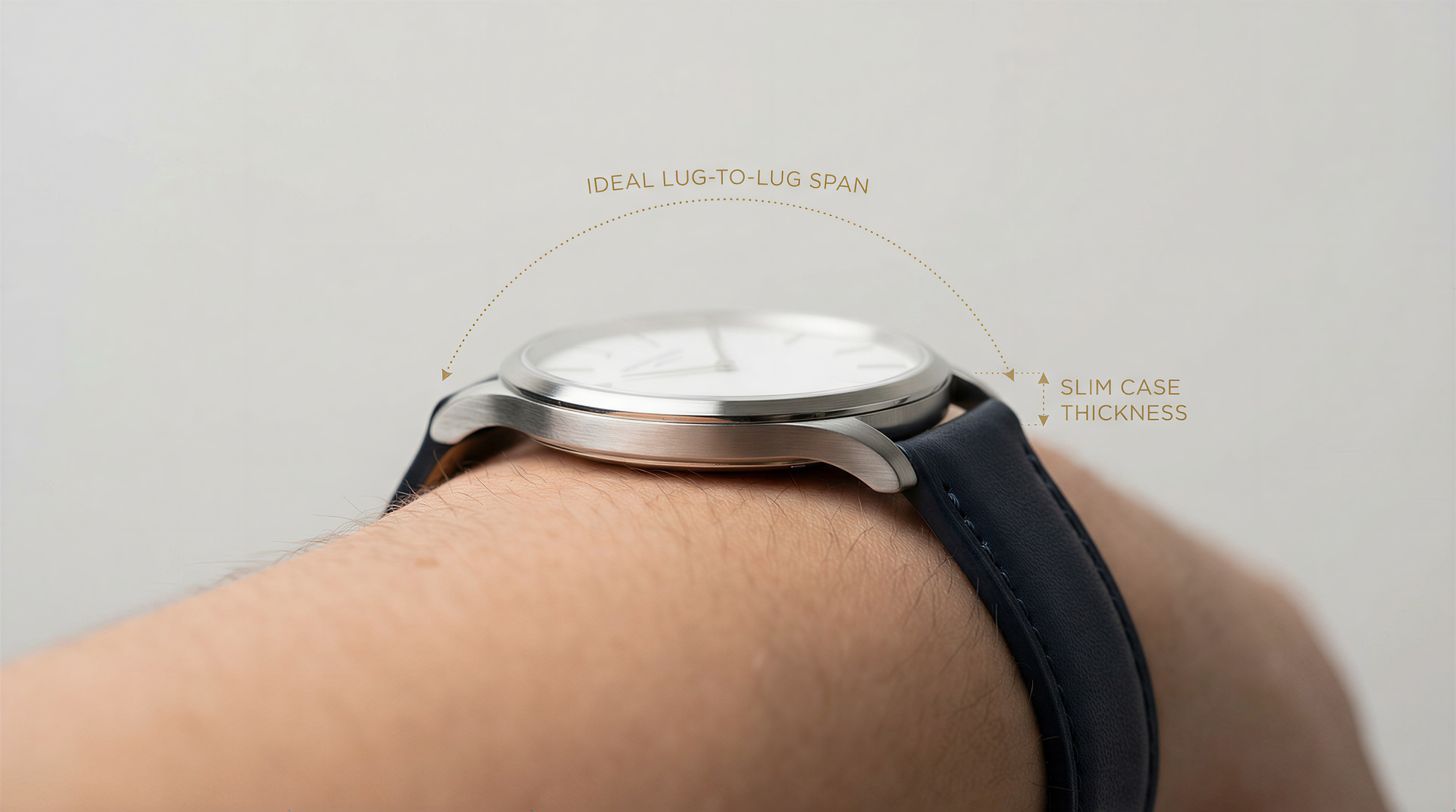
If case diameter is the headline, lug-to-lug distance is the truth. The lugs are the extensions at the top and bottom of the case where the strap attaches. The lug-to-lug measurement is the vertical distance between the tips of those extensions — and it is this number that determines how the watch sits across your wrist.
The rule: lug-to-lug distance should fall between 75% and 95% of your flat wrist width, and the lugs must never overhang the wrist's edge.
A 42mm case with compact lugs can wear more comfortably than a 38mm case with sweeping lugs. Always check the lug-to-lug specification before buying, especially online.
Pro tip: Curved lugs hug the wrist and are ideal for smaller wrists. Flat lugs cause the watch to sit proud of the wrist, which disrupts the clean line that minimalist aesthetics depend on.
5. Case Thickness and the Minimalist Profile
Thickness is where minimalism lives or dies. A case that rises high off the wrist shatters the line of a shirt cuff, snags on fabric, and broadcasts its presence. The minimalist ideal does the opposite — it disappears into the outfit.
| Thickness Category | Case Height | Suitability for Minimalism |
|---|---|---|
| Ultra-thin | Under 7mm | Exceptional — the gold standard |
| Thin | 7mm – 10mm | Excellent — slides under any cuff |
| Average | 10mm – 15mm | Acceptable — depends on case shape |
| Thick | 15mm+ | Avoid for minimalist contexts |
Brands like Nomos, Junghans, A. Lange & Söhne, and Piaget have built their reputations on achieving ultra-thin profiles without sacrificing movement quality. The Bvlgari Octo Finissimo Ultra Mark II — at just 1.7mm — represents the extreme of this pursuit.
One caveat: domed crystals and convex case backs add perceived height that official specifications do not capture. Always account for these when evaluating thin-profile watches.
6. 2026 Trend: The 36–38mm Sweet Spot
The numbers confirm what connoisseurs have sensed for years. Following decades of escalating case sizes that peaked around 44–46mm in the mid-2010s, the industry has returned to the proportions of the mid-twentieth century. Rolex moved the Explorer back to 36mm in 2021. Tudor launched the Ranger at 36mm. Christopher Ward released the Twelve Ti at 36mm. The 2025–2026 consensus across collectors, retailers, and trend analysts is clear: 36–38mm is the new standard for refined, everyday wear.
This shift is also blurring traditional gender distinctions. Men are embracing slimmer, more refined cases. Women are exploring bolder proportions. The watch is becoming a genuinely personal object — chosen for what it says about the individual, not what category it is sold under.
7. How to Measure Your Wrist
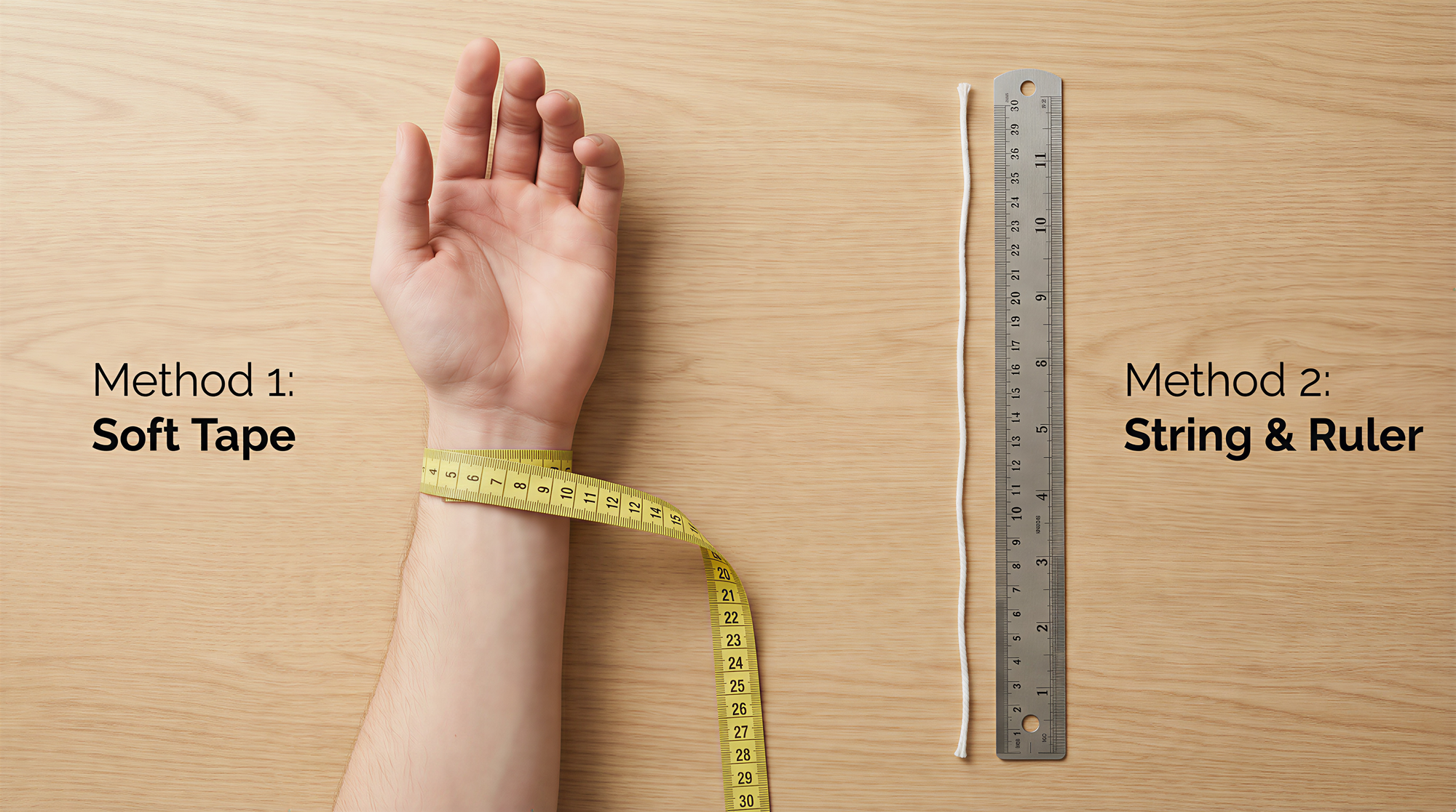
Method 1 — Soft Measuring Tape (Most Accurate)
Wrap a flexible measuring tape snugly around your wrist just below the wrist bone — the natural position where you wear a watch. Ensure it sits flat and without constriction. Note where the tape overlaps. Measure your non-dominant hand for the most consistent result. Record in both inches and centimetres.
Method 2 — String and Ruler
Wrap a piece of non-stretch string around the same position on your wrist. Mark the overlap point with a pen. Lay the string flat against a ruler. This method is slightly less precise but entirely reliable for identifying the right size bracket.
Once you have your circumference, use the sizing table in Section 1 and cross-reference with the 60–75% rule in Section 2.
If you want to skip the endless scrolling and get straight to the best timepieces, I’ve done the heavy lifting for you.
My Minimalist Watch Finder & Digital Sizing Guide is a curated, interactive tool designed to help you filter through the world’s best minimalist watches by case diameter, lug-to-lug, and thickness. It includes:
Curated Databases: Direct links to the top-rated minimalist watches for every wrist size.
Printable Sizing Ruler: A high-precision tool to measure your wrist at home.
The 2026 Style Matrix: Updated for this year’s "Neo-Vintage" sizing trends.
Download the Watch Finder on Etsy →Minimalist Watch Buying Guide
8. The Three Fit Mistakes That Ruin a Minimalist Silhouette
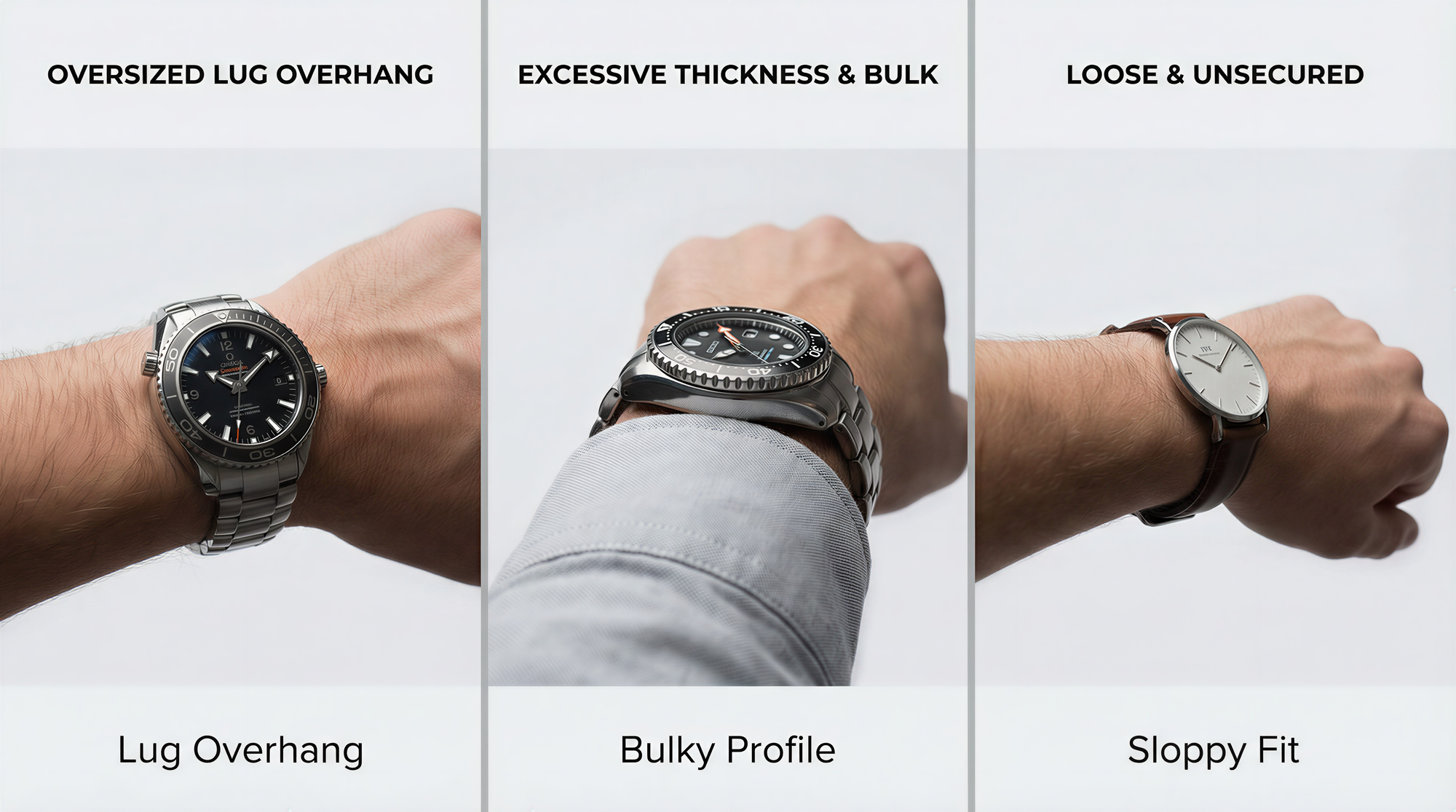
Getting the numbers right is necessary. Avoiding these three errors is essential.
| Mistake | What It Looks Like | Why It Matters |
|---|---|---|
| Lug overhang | Lugs extend past the wrist edge | Creates an unbalanced, top-heavy appearance — the most critical error |
| The "wrist bump" | Thick case bulges under shirt cuff | Destroys the flat, streamlined aesthetic central to minimalism |
| The loose slide | Watch slides up and down the arm | Looks careless and exposes the case to unnecessary impact |
The correct fit is simple: one index finger should slide between the strap and your wrist. The watch should sit centred, stable, and still. It should be present when you look for it and invisible when you don't.
Final Thought
The best minimalist watch is the one you forget you're wearing — until someone else notices it. Getting the size right is not about following rules for the sake of them. It is about understanding the proportions that allow a beautifully made object to sit exactly where it belongs: quietly on the wrist, doing precisely what it was built to do.
Measure carefully. Choose deliberately. Wear confidently.